How to Build Confidence Before a Performance When Nerves Take Over
Fadi

Your event is close. You have trained, rehearsed, or prepared, but your mind keeps replaying what could go wrong. Maybe your breathing feels shallow, your legs feel restless, or you are comparing yourself with someone who looks completely calm. If you are searching for how to build confidence before a performance, start here: confidence is not the absence of nerves. It is knowing what to do while nerves are present.
That distinction matters for young athletes and performers. You cannot always choose how your body responds to a competition, audition, showcase, or presentation. You can choose how you prepare, where you place your attention, and what you say to yourself in the moments before you begin. Those choices give you a practical route back to clarity.
This guide offers a flexible routine, not a promise that you will feel fearless. Use it to create a little more steadiness and trust in your preparation. Adapt the steps to your sport, performance setting, coach’s instructions, and personal needs.
How to build confidence before a performance starts with controllable actions
Confidence is often treated as a feeling you must find before you can act. That can make the wait feel frustrating: you check whether you feel ready, notice that you are still nervous, and take that as evidence that you are not prepared.
Try a different definition. For this guide, confidence means being willing to take the next useful action without needing a perfect feeling first. You might still feel butterflies. You can also know your opening move, remember your cue, and take one deliberate breath.
Separate the event into two lists. The first holds what is outside your direct control: the judge’s opinion, the opponent’s choices, the crowd, the weather, or whether a casting decision goes your way. The second holds actions you can influence: arriving with the right equipment, warming up as planned, reviewing one cue, and asking a clear question if you need information.
Do not use the first list to judge yourself. Use the second to decide what to do next. This is not pretending the uncontrollable parts do not matter. It is choosing not to spend your last preparation minutes trying to control them.
Build a pre-performance routine that fits your event
A routine is a short sequence you can repeat, rather than a strict ritual that must happen perfectly. It gives your attention somewhere useful to land. The steps below are a framework you can adapt, not a branded or guaranteed method.
1. Name the moment you are preparing for
Be specific. “I need to be confident” is difficult to act on. “I need to complete my first serve routine,” “I need to enter the room and deliver my first line,” or “I need to start the first section of my floor routine” gives you a visible next step.
Write one sentence: “When it is time to begin, my first task is ___.” Keep it tied to an action you can perform, not an outcome you cannot guarantee. For an example, a volleyball player might write, “When the whistle goes, I set my feet and read the server.” A singer might write, “When the accompaniment starts, I release my jaw and take my starting breath.”
2. Choose one cue, not a speech
A cue is a brief word or phrase that directs your attention. It could be “tall,” “see the ball,” “soft shoulders,” or “listen for the first note.” Choose a cue you understand and can use in the setting where you perform.
Long pep talks can become another thing to remember. A short cue is easier to return to if your mind wanders. Test it in practice first. If a phrase makes you tense or distracts you, choose a simpler one. Your cue should guide the action, not criticize you into doing it.

3. Use a brief body check
Before you begin, notice three things: your feet or seat, your breathing, and one area that is holding tension. You are not trying to force your body into total relaxation. You are checking in so you can make a small adjustment.
If it feels comfortable, let one breath out slowly and allow your shoulders or hands to soften. Keep breathing in a way that feels safe for you. Some people feel light-headed when they deliberately change their breathing, so do not force a technique. If breath focus does not suit you, use a physical anchor instead, such as feeling both feet on the floor or noticing the grip of your equipment.
4. Recall evidence from preparation
Confidence becomes more grounded when you connect it to something real. Identify one relevant action you have practiced: your warm-up, a transition, a recovery plan, or the first part of your routine. Avoid making the claim “I cannot fail.” You do not need that claim to take part.
For example, a dancer could think, “I have rehearsed the entrance and know the first count.” A runner could think, “I have a pacing cue for the opening stretch.” This is an example of useful self-talk, not a report of a client result.
5. Point your attention outward
Once you have checked in, return to the task. Look for the next relevant signal: the coach’s instruction, a teammate’s position, the stage mark, the starting signal, or the first sound. Attention that stays fixed on “Do I feel confident yet?” may pull you away from the performance itself.
Ask, “What is the next thing I need to notice?” That question is useful whether you feel calm, energized, or nervous.
Match the routine to the time you actually have
You do not need a long routine or a perfect quiet space. The right sequence is one you can use without disrupting required preparation. Follow your coach’s or event staff’s safety and warm-up instructions first. Here are sample versions you can adjust:
| Time available | What to do | Example |
|---|---|---|
| About one minute | Name the first task, use one cue, and notice a physical anchor. | “First serve: read the server.” Feel both feet, then look toward the court. |
| About five minutes | Review one controllable action, check your body, and rehearse the opening mentally once. | Picture entering the room, finding your mark, and delivering the first line. |
| About fifteen minutes | Complete your normal preparation, then use a short check-in and return to the next task. | Finish the prescribed warm-up, check equipment, choose a cue, and follow the event’s call time. |
These are examples, not required durations. If your warm-up, travel, accessibility needs, or event schedule calls for a different plan, use the plan that fits. A routine should support preparation, not make you late or replace appropriate coaching, medical advice, or safety procedures.
What to do when nerves spike
Sometimes your routine works for a moment and then a thought lands: “What if I mess up?” “Everyone is watching.” “I have to prove I belong here.” Trying to argue every thought away can eat up attention. Instead, acknowledge the thought and make a small return to the task.
- Name it neutrally. Say to yourself, “I’m noticing a worry,” or “My body is switched on.” You are describing an experience, not predicting the result.
- Choose a task cue. Return to the cue you picked, such as “listen,” “first step,” or “see the target.”
- Do one physical action. Set your stance, adjust your equipment if appropriate, or move to your mark. Let the action lead you back into preparation.
- Make room for uncertainty. You do not need to know exactly how the performance will go before you start.
Imagine, as an example, a young swimmer waiting behind the blocks and noticing a rush of worry after hearing the heat announced. Their useful response is not to demand instant calm. They can identify the worry, use a practiced cue such as “long line,” check that they are following the meet’s instructions, and focus on the next step in their start routine.
If anxiety feels overwhelming, keeps you from participating, or affects your wellbeing beyond performance situations, consider talking with a qualified mental health professional or healthcare provider. A coach can support skill practice, but should not replace care that needs a licensed professional.
Use self-talk that is honest and useful
Positive self-talk is not about repeating statements you do not believe. “I’m definitely going to win” can add pressure because the outcome depends on many factors. Choose words that are credible, kind, and connected to action.
- Instead of “I can’t be nervous,” try “I can feel nervous and still follow my routine.”
- Instead of “I must be perfect,” try “I’ll focus on the next cue.”
- Instead of “I’m behind everyone,” try “My task is to perform my prepared role.”
- Instead of “If I make a mistake, it’s over,” try “If I lose focus, I can return to the next useful action.”
Adjust the language until it sounds like something you might genuinely say. If a phrase feels forced, make it more neutral. “I’m here, and my first task is clear” may be more useful to you than an enthusiastic slogan.
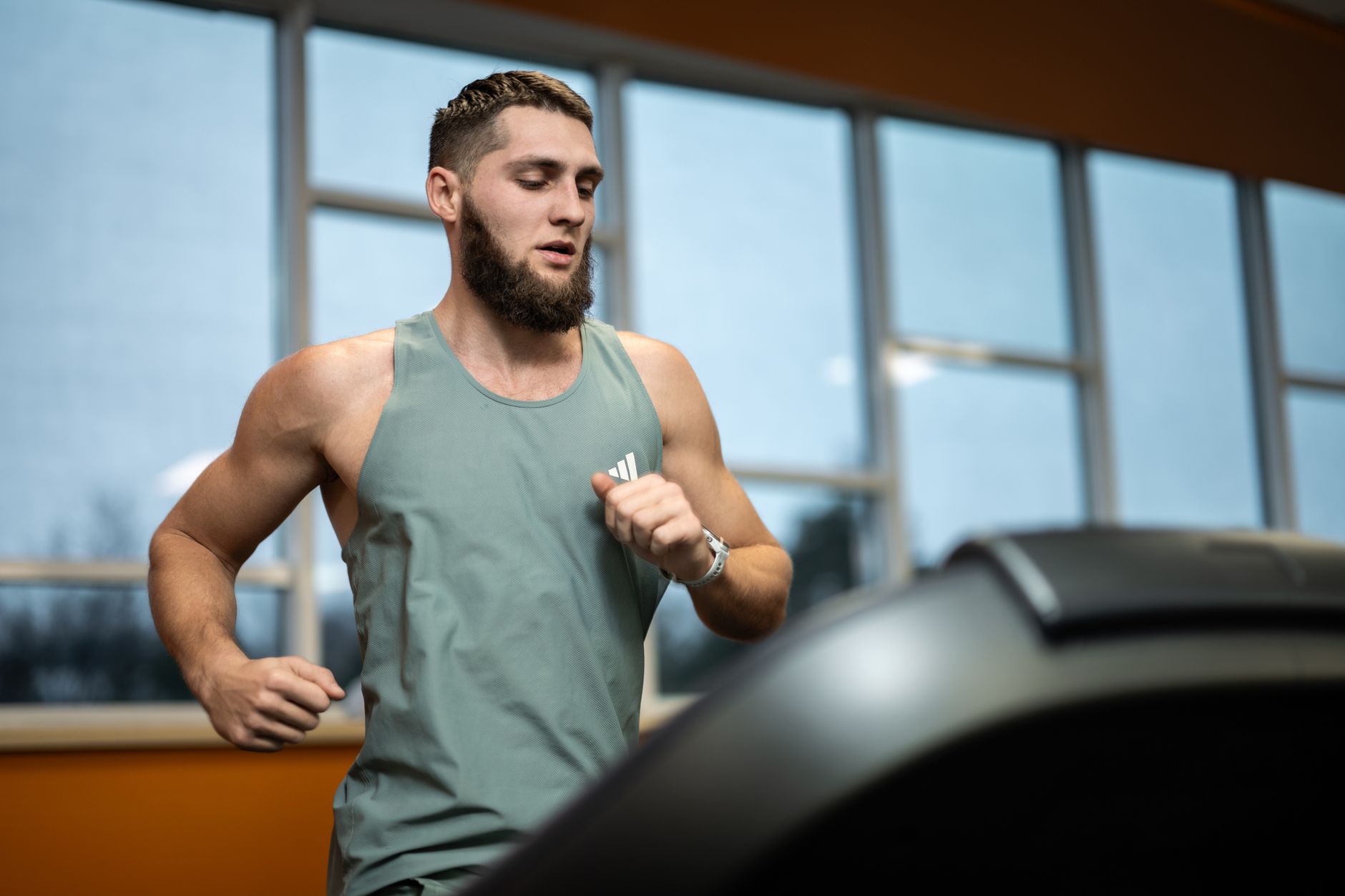
Confidence before a performance is not proof that everything will go perfectly. It is a clear next action you can take, even when you feel nervous.
Plan for a mistake before the event
Many athletes and performers prepare for the ideal version of a performance but do not decide what they will do after a wobble. A simple reset plan gives you a way back into the task. It does not erase a mistake, and it does not guarantee a particular result. It helps you avoid turning one moment into a verdict on your ability.
Write a three-part reset that fits your activity:
- Notice: identify what happened without adding an insult. “I missed the note” is information. “I always ruin everything” is a sweeping judgment.
- Reset: use one familiar action, such as a breath out, a posture adjustment, or a brief cue. Follow any rules of your sport or performance setting.
- Rejoin: identify the next playable or performable moment. In a team sport, that may mean getting into position. In a speech, it may be finding the next sentence.
For an example, a basketball player who misses an early shot might use “next defensive job” as a cue and get back into position. A musician who loses a place might follow a rehearsed recovery point, if their arrangement and teacher have prepared one. The right reset is specific to the activity. Practice it in low-stakes sessions so the steps are familiar, and get guidance from a qualified coach or instructor on the technical details.
Practice your routine without making it another test
Try the routine during training or rehearsal, not only on the day that matters. That lets you find out whether the cue is clear, the sequence fits your schedule, and any body-based step feels comfortable. You can also learn which parts help you return to your task and which parts feel like extra pressure.
After a practice, make a brief note:
- What was my first task?
- Which cue helped me focus on something relevant?
- What did I do when my attention drifted?
- What would I simplify next time?
Keep the review factual and short. The goal is not to grade your personality or decide whether you are a confident person. It is to make the routine more useful. If your schedule is full, write one line on your phone or notebook after practice rather than adding a separate training block.
How to adapt the routine for an online course or solo practice
If you are learning through an online course or training independently, you can still build confidence through repeatable practice. Set up a small sequence before you press play or begin your session: identify the skill you are practicing, choose one cue, and decide what you will do if you feel stuck. Keep the goal within the session, such as completing one drill with attention to form, rather than judging yourself by how quickly you progress.
Use course material as a guide, not as a reason to ignore your body or the coaching available to you. Pause when instructions are unclear. Ask a qualified instructor for feedback when you need it, and stop if you feel pain or an unsafe level of discomfort. Confidence grows through informed participation, not by pushing past every signal.
For an example, a performer practicing a monologue alone might choose a single intention for one run-through, record the first minute, and review whether they maintained the intention. They do not need to decide from one recording whether they are talented. They are collecting information about a skill they can work on.
Make a plan you can use today
Before your next competition, rehearsal, audition, or performance, write down four things: your first task, your one cue, your physical anchor, and your reset action. Keep the plan short enough to remember. Test it once in a practice setting and adjust anything that feels distracting or impractical.
Here is a blank structure you can complete in your own words: “When it is time to start, I will ___. My cue is ___. I will notice ___. If I lose focus, I will ___.” For an example, a tennis player might write: “When the point starts, I will watch the toss. My cue is ‘see it.’ I will notice my feet on the court. If I lose focus, I will reset at the next point.”
Your routine does not need to make you feel invincible. It should help you meet the moment with more clarity, respect for your preparation, and a next step you can actually take. Keep practicing that return to the task. Each time you choose a useful action instead of waiting for perfect confidence, you build a more dependable relationship with performance.


